 |
|
More Related Stories |
| Page (1) of 2 - 03/26/03 |
 email article email article |
 print
page print
page |
The article in question, of course, is the now-infamous "PC Preferred" document that appears on Adobe's Web site at http://www.adobe.com/motion/pcpreferred.html. In it, Adobe uses benchmark results showing how After Effects 5.5 renders much, much more quickly on an Intel-based system than on a Motorola-based system. There's nothing particularly extraordinary in that, except for the inexplicably inflammatory anti-Macintosh tone (and nomenclature) of the Adobe article, especially given that Mac users make up 28 percent of Adobe's market and a whopping half of the total creative production market. What is extraordinary is how eager this article makes Adobe seem to advertise the shortcomings of its own software's performance.
Before I go on, let me emphasize something. I'm not a Motorola apologist. I use a Mac because of the environment and workflow, and I don't care in the least what piece silicon is buried beneath a heat sink hidden inside my computer's case, as long as it gives me some decent performance for my money. It's irrelevant. What is relevant is how well software is written for any given chip, any given system architecture, any given OS.
Now, being familiar enough with Charlie's benchmark features, I have no doubt as to the accuracy of the data. Charlie--as much as I wish otherwise--conducts his tests evenly and bases them on common tasks professional users certainly do engage in. And, at times, I've double-checked his figures and even contributed my own benchmark tests for him to use because I didn't want to believe what I saw: that a Pentium 4-based machine could not only be faster than a Mac, but significantly faster ... with Adobe software.
But why is it faster? Yes, gigaHertz do mean something. But what happens when you look not at comparisons between Intel- and Motorola-based systems but between single- and dual-processor Mac systems? Well, take a look at the following chart showing relative performance between three applications running on single- and dual-processor Mac systems.
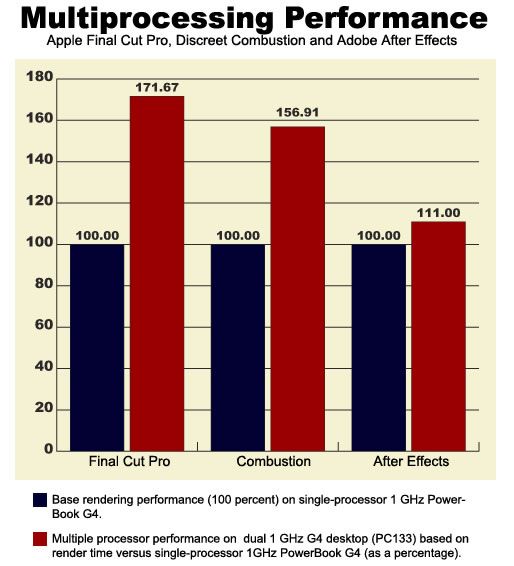
These tests were conducted using various built-in filter effects and image operations on a variety of Mac-based systems, and, as you can see, After Effects itself (Production Bundle, no less) is not exactly a model of multiprocessor efficiency. Where, on average, Final Cut Pro 3 rendered compositions in 58.25 percent the time on a dual-processor systems and Combustion 2 rendered at 63.73 percent the time, After Effects pulled off a mere 90.09 percent. (You can find more examples of these benchmarks here, here and here, along with more details of the elements involved in the tests.)
Now, let's say After Effects could handle dual processors on a Mac as well as Final Cut Pro--that is, that render times on a dual-processor system could be cut down to 58.25 percent of their current speeds. What would happen? In the tests Charlie White conducted and that Adobe cites in its article, the Mac would actually see slightly better render times than the Dell Precision Workstation 3.06 GHz P4 in some cases, while running neck and neck in others. But there certainly wouldn't be the disparity cited by Adobe and Charlie.
In other words, it isn't the processor or the operating system; it's the software.
Related Sites: Creative Mac , Digital Video Editing , Siggraph News , Broadcast Newsroom , Digital Media Designer , DTV Pro , Acquisition & Production , Oceania , MacAnimationPro
Related Newsletter:
To Comment on This Article, Click HERE
Most Recent Reader Comments:
Click Here To Read All Posts
Must be Registered to Respond (Free Registration!!!, CLICK HERE)
Digital favorites
- Casino Online Non Aams
- Betting Sites UK
- Casino UK Sites
- Casino Online Non Aams
- Casino Non Aams
- Casinos Not On Gamstop
- UK Online Casinos Not On Gamstop
- Meilleur Casino En Ligne
- Crypto Casinos
- Casino Online Italia
- Migliori Giochi Casino Online
- Meilleur Casino En Ligne Français
- Casino En Ligne
- Meilleur Casino En Ligne Francais
- Siti Scommesse Non Aams
- Siti Poker Online Migliori
- Meilleur Site De Poker
- Site De Paris Sportif Nouveau
- Sweet Bonanza Fruits Avis
- Parier Sur Ufc
- Fm카지노 가입코드
- 비트코인 스포츠베팅
- Casino Jeux En Ligne
- Sites De Paris Sportifs
- Casino En Ligne Argent Réel
- Cresus Casino Avis
- Migliore Casino Non Aams
- Meilleur Casino En Ligne
- Meilleur Casino En Ligne 2026
- Casino En Ligne Fiable
- Casino En Ligne
- Migliori Casino Crypto
- Bonus Free Spin Senza Deposito
- Casino Online Non Aams Sicuri
- Migliori Siti Scommesse Non Aams
- Meilleur Casino En Ligne De France
- Casino En Ligne
- Casino En Ligne Fiable
- Trusted Online Casino Malaysia
- Nouveau Casino En Ligne 2026
- オンラインポーカー
- Casino En Ligne Cashlib
Source:Digital Media Online.
All Rights Reserved


